MY DATE NEVER ARRIVED… BUT THEN THREE IDENTICAL LITTLE GIRLS TOOK A SEAT BESIDE ME AND SAID, “OUR DAD IS SO SORRY HE COULDN’T MAKE IT ON TIME.”

I arrive at Maple & Vine Café in Brooklyn Heights a few minutes early, as if being on time might somehow convince me that life is still manageable—even when it clearly isn’t.
The café smells of cinnamon and espresso, while soft golden lighting makes the room feel calmer than my thoughts. I choose a seat near the window, order chamomile tea in an attempt to appear relaxed, and place my phone face-down on the table, as if it could protect me from disappointment.
Paula—my closest friend and self-appointed matchmaker—swore this man was different.
“Warm eyes,” she told me. “Stable. The kind of person who deserves something real.”
I reminded her that I was exhausted by charming men and empty promises disguised as destiny. She only laughed.
“One cup of coffee,” she said. “If it’s awful, you can blame me forever.”
I glance at the clock.
Then again.
Seven o’clock arrives and quietly passes. The chair across from me remains empty. Familiar doubts begin creeping into my mind—maybe I misunderstood, maybe I’m always someone’s second choice—but I force those thoughts away. Ten minutes late isn’t catastrophic.
At least not yet.
Then a small voice interrupts my thoughts.
“Excuse me… are you Emma?”
I lift my eyes, expecting to see a man in a blazer.
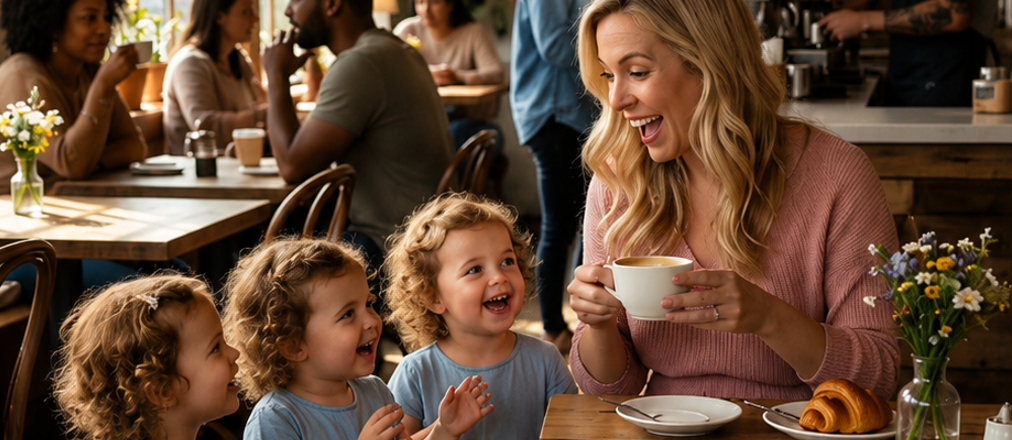
Instead, I find three identical little girls standing beside my table.
Matching red sweaters. Blonde curls. Expressions far too serious for children their age.
“We came because of our dad,” one of them says carefully.
Another nods. “He feels terrible for being late.”
“There was a work emergency,” the third explains.
I blink in confusion.
Blind dates are not supposed to involve triplets.
I glance around the café, expecting a parent or babysitter to suddenly appear. Nobody does. The barista is openly watching now, and several customers are smiling at the scene unfolding nearby. The girls seem perfectly safe—and strangely confident.
“Did your father send you?” I ask gently.
“Well… not exactly,” the first girl admits. “He doesn’t know we came yet. But he’s coming.”
“Definitely,” the second says firmly.
“Can we sit down?” the third asks politely. “We’ve really wanted to meet you.”
Something inside me softens immediately.
“Alright,” I reply, pulling out the empty chairs. “But I expect the full story.”
The girls climb into their seats as though they’ve rehearsed this moment.
“I’m Harper,” the first says proudly, shaking my hand.
“I’m Maddie,” says the second with a bright smile.
“And I’m June,” the third whispers. “We’re not very good at keeping secrets.”
I laugh unexpectedly—a real laugh I didn’t know I needed.
The girls explain that they overheard their father speaking with Aunt Paula about meeting “Emma” at the café that evening. Harper mentions he kept adjusting his tie. Maddie insists he never adjusts his tie. June nods seriously, as though that alone proves how important the evening was.
“He had to return to work,” Harper explains. “But we didn’t want you to think he forgot about you.”
“And technically, we didn’t lie to the babysitter,” Maddie adds quickly. “We just assumed Dad would say yes afterward.”
June gently places her tiny hand over mine.
“We’re trying to stop Dad from giving up on happiness.”
The words hit me harder than I expected.
I ask why this matters so much to them, and suddenly their confidence fades into something softer.
“He’s been sad for a long time,” Maddie says quietly.
“He smiles around us,” Harper adds, “but when he thinks nobody’s watching, he looks lonely.”
“He does everything for everyone else,” June whispers. “But nothing for himself.”
I understand that kind of loneliness all too well. I’ve lived with it myself.
Eventually, they tell me about their mother—a famous actress they mostly see on television. There’s no bitterness in their voices, only acceptance. She loved them, but she loved her career more. Sometimes people leave.
Then the café door suddenly swings open.
A man rushes inside, his tie crooked, his hair messy, panic written all over his face. His eyes immediately land on our table.
“Oh no,” Harper murmurs.
“He found us,” Maddie says proudly.
“Mission accomplished,” June whispers.
He reaches the table, breathless.
“I’m so sorry,” he says quickly. “I’m Daniel Brooks. I had no idea they—”
He stops, staring at his daughters in disbelief.
“So you’re the man who accidentally abandoned me on a blind date,” I tease lightly.
The embarrassment on his face is immediate—and genuine.
“I swear it wasn’t intentional.”
“She’s not upset,” Harper assures him.
“We explained everything,” Maddie says proudly.
“And she likes us,” June finishes softly.
She’s right.
I do.
Dinner still happens that night—chaotic, loud, and far from perfect. Later, at Daniel’s house, surrounded by children’s drawings and handwritten notes taped to the refrigerator, I notice something that quietly steals my breath away.
On the family calendar, written carefully in black marker, are the words:
Date with Emma.
He had made room for me before we had even met.
Later that evening, after bedtime stories are finished and the house grows quiet, Daniel thanks me for staying. He admits he’s afraid—afraid of trusting someone again, afraid his daughters might get hurt.
“I know what it feels like to be abandoned,” I tell him softly. “I would never do that to you.”
After that, everything unfolds slowly.
School recitals. Burnt pancakes. Tiny drawings left on the kitchen counter with my name written in crayon. Little by little, something fragile and hopeful begins to grow between us.
When the girls’ mother eventually returns with cameras, attention, and demands, the girls make their choice bravely. They choose love that stays.
She leaves again.
One year later, back at Maple & Vine Café, Daniel kneels in front of me while the girls stand beside him holding a crooked handmade sign asking me to stay forever.
And without hesitation, I say yes.