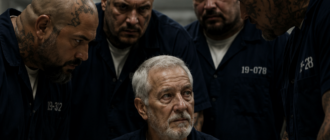
For Thirty-Five Years, My Husband Locked Himself in the Bathroom Every Morning at 4 A.M. The Night I Looked Through the Keyhole, I Finally Learned Why.
“If you ask me one more time what I’m doing in there at four in the morning, I swear I’ll leave this house.”
That was the warning my husband, Richard, gave me after thirty-five years of marriage.

My name is Eleanor Mitchell. I’m seventy-eight years old, and for most of my life, I believed I knew everything there was to know about the man I married. Richard was dependable, hardworking, and quiet.
We met at a church fundraiser in 1969, married the following year, and raised two children, Michael and Claire, in a modest home on the south side of Chicago.
But there was one mystery I could never understand.
Every single morning, without fail, Richard woke up at exactly 4:00 a.m., went downstairs to the bathroom, locked the door, and stayed inside for nearly an hour.
At first, I thought it was a health issue. Later, I wondered if he was hiding an addiction, praying in secret, or talking to someone. None of it made sense. He didn’t drink, didn’t smoke, and never disappeared for long periods of time.
Yet from behind that locked door, I would sometimes hear running water, pill bottles clinking together, wrappers being torn open, and every so often, a muffled groan.
Whenever I asked about it, he shut down immediately.
“There’s nothing to talk about,” he would say.
As the years passed, I noticed other strange things. Richard never wore short sleeves, even during the hottest summers.
He never changed clothes in front of me. During intimate moments, he insisted the lights stay off. If I touched him unexpectedly, his entire body would tense up.
One evening, after years of frustration, I asked if there was another woman.
The look of fear that crossed his face shook me.
“Don’t say that,” he whispered.
“Then tell me what you’re hiding.”
For the first time in our marriage, I saw him cry.
“I’m doing this to protect you.”
That answer frightened me more than any confession could have.
Everything changed one morning in March.
I pretended to be asleep as Richard quietly removed a pharmacy bag he had hidden in the closet before heading downstairs.
A few minutes later, I followed him and looked through the bathroom keyhole.
What I saw stole the air from my lungs.
Richard had taken off his shirt.
His back was covered in horrific scars—burn marks, deep indentations, and twisted patches of damaged skin stretching across his shoulders and ribs.
Some looked decades old. Others appeared inflamed even now.
Standing at the sink, he carefully cleaned an open wound while biting down on a towel to keep from screaming.
I returned to our bedroom in tears.
The man who had shared my life for thirty-five years had been suffering in silence, and I had never known.
The next day, I searched the closet. Inside the bag were burn creams, pain medication, gauze, medical tape, and bloodstained bandages.

For years, I had suspected betrayal.
The truth was far worse.
When I tried bringing up the past, Richard immediately withdrew. Our son Michael admitted he had always felt his father was distant. Old resentments resurfaced, and he confessed that he had grown up believing his father didn’t love him.
Before leaving the room, Richard quietly said:
“You’re right. Everyone suffered because of me.”
Two weeks later, he collapsed in the yard while repairing a water pipe. One of the wounds on his back had reopened.
Michael arrived just in time to see the scars for the first time.
The shock on his face was heartbreaking.
“Dad… what happened to you?”
That evening, surrounded by his children, Richard finally told the truth.
It all began in 1972.
At the time, he volunteered through his church, helping struggling families. One night, two men forced him into a car, blindfolded him, and took him to a secret location.
For four days, they interrogated and tortured him.
They believed he was another Richard Mitchell involved in political activities. No matter how many times he insisted they had the wrong man, they refused to believe him.
Eventually, they realized their mistake.
Before releasing him, they threatened him. If he ever spoke about what happened, they would come after me.
So he stayed silent.
The burns, scars, and nerve damage followed him for the rest of his life. The pain never disappeared. Neither did the shame.
“I thought surviving made me weak,” he admitted.
Suddenly, everything made sense—the locked bathroom door, the long sleeves, the emotional distance, and the fear that had haunted him for decades.
Michael broke down and apologized. Claire was crying too. For the first time, our family understood the burden Richard had carried alone.
From that day forward, he stopped locking the bathroom door.
Every morning at four o’clock, I sat beside him while he treated his wounds. We found specialists, attended therapy, and got him the help he needed. Recovery was slow, but he was no longer alone.
Richard lived fifteen more years.
Shortly before he passed away in 2019, he squeezed my hand and whispered:
“Thank you for not leaving me alone with my shame.”
I smiled and answered softly:
“It wasn’t shame. It was pain.”
I’m sharing this story because so many families mistake trauma for coldness, silence for indifference, and distance for a lack of love.
Not every secret hides a betrayal.
Sometimes, behind a locked door, there’s simply someone doing everything they can to survive.