That year alone, my neighbor Denise had borrowed at least ten different things from me—my ladder, pressure washer, slow cooker, food steamer, cooler, and roasting pan, among others. Nearly every item was returned late, grimy, damaged, or with some part missing.
Whenever I confronted her about it, Denise always had an explanation ready.
“I was planning to clean it.”

“Wasn’t that scratch already there?”
Or her personal favorite: “You know what kids are like.”
I should have stopped loaning her my belongings long before she ever asked for my mixer.
Unfortunately, saying no had never been one of my strengths.
One Tuesday afternoon, Denise showed up at my front door.
“Please tell me you have a stand mixer.”
“I do.”
“The cream-colored one?”
My stomach immediately tightened.
That old KitchenAid had belonged to my mother.
She purchased it in 1989 and used it almost every Sunday until she eventually became too frail to cook.
After she passed away, I chose to keep the mixer because hearing it run always took me back to Sunday mornings in my parents’ kitchen.
“No,” I replied.
“I really don’t want to lend that one out.
It belonged to my mom.”
“I’ll take good care of it.
I only need it for one cake.”
Eventually, I gave in.
“All right.
Just please make sure it’s clean when you bring it back.”
“Of course.”
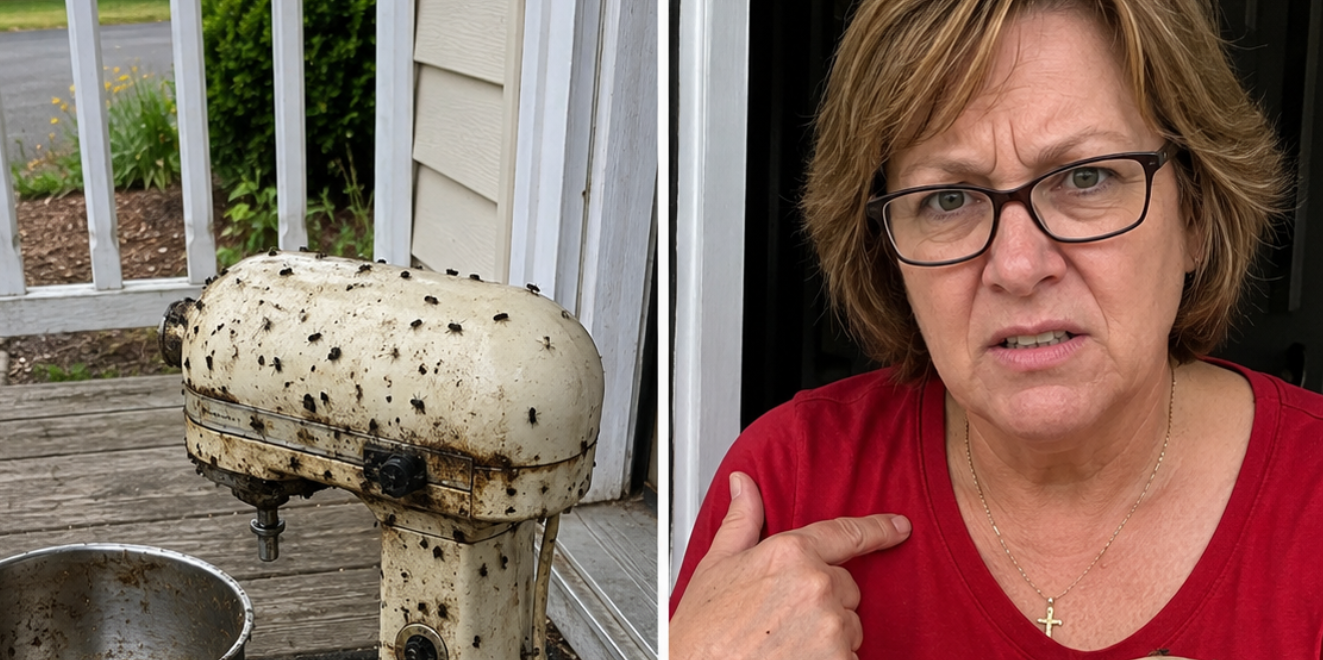
Saturday morning, I opened my front door and found the mixer sitting abandoned beside the welcome mat.
Dried cream was crusted around the seams.
Hardened frosting covered the whisk attachment, and some sticky residue had dried along the electrical cord.
I spent nearly twenty minutes cleaning it before plugging it in.
The motor made an awful grinding noise, lurched once, and then died.
My daughter, Sophie, looked at me in shock.
“Grandma’s mixer is broken?”
I immediately walked over to Denise’s house.
“The mixer isn’t working.”
She hardly seemed concerned.
“Honestly, you should probably just replace it.
That thing is ancient.”
“What happened to it?”
“It started making some horrible noise while I was mixing frosting, and then it stopped spinning.”
“Did you shut it off when it started struggling?”
“I had eleven people waiting for cake.”
Then she shrugged.
“So thanks for ruining my night.”
I couldn’t believe what I was hearing.
She had borrowed my mixer, damaged it, returned it filthy, and somehow managed to make me responsible.
The following day, I took it to a repair shop.
The technician, Greg, examined the motor.
“It overheated,” he told me.
“Someone overloaded it and continued running it even after the motor started struggling.”
“So this didn’t happen just because it’s old?”
“These mixers are built to last forever.
This isn’t normal aging or wear.”
The repair estimate came to $347.
I sent Denise a photo of the estimate and asked her to cover the cost.
Twenty minutes later, she responded.
“LOL, absolutely not.
I’m not paying $347 to repair some mixer from the 1980s.
You should be thanking me.
Now you finally have an excuse to buy a new one.”
I paid for the repair myself.
A few days later, Denise appeared at my door again.
Her niece’s graduation celebration was approaching.
“I need your large cooler, slow cooker, and two folding tables.”
I stepped inside and came back carrying a clipboard.
She stared at it.
“What’s that?”
“A borrowing agreement.”
I had written down every item along with its replacement value.
Everything had to be brought back clean, dry, undamaged, and no later than Sunday at 6 p.m.
Refundable security deposit: $350.
Unpaid mixer repair: $347.
Her eyes widened.
“You seriously expect me to hand you almost seven hundred dollars?”
“The $350 comes back to you if everything is returned properly.
The other $347 is the money you already owe me.”
“This is ridiculously petty.”
“Then you don’t have to borrow anything.”
She turned around and stormed off.
Saturday morning, Denise came back looking desperate.
The rental company had delivered chairs for the graduation party but forgotten the tables, and her guests would be arriving in two hours.
“Can I please borrow yours?”
I brought out the clipboard again.
This time, she wrote me a check for $697.
I helped carry everything over to her house.
My goal wasn’t to sabotage her niece’s graduation party.
I simply wanted Denise to treat my property with basic respect.
On Sunday afternoon, she returned everything exactly on time and in perfect condition.
The cooler was completely dry, the slow cooker had been washed, and both tables were clean and neatly folded.
I handed her the $350 security deposit.
She looked at me.
“What about the mixer money?”
“That wasn’t part of the deposit.
The repair shop already has that.”
She frowned.
Then I told her what had actually bothered me most.
“You believed the mixer stopped working because it was old, but you still dumped it dirty on my porch.
If you had come to the door, explained what happened, and apologized, this situation would have ended very differently.”
For once, Denise had nothing to say.
After a moment, she quietly admitted, “I shouldn’t have left it there like that.
And I shouldn’t have blamed you.
I’m sorry.”
Two days later, Greg called to tell me the mixer was ready.
When he switched it on, the motor purred smoothly, sounding exactly the way I remembered.
That weekend, Sophie and I used it to bake my mother’s chocolate cake.
Several months later, Denise asked if she could borrow my pressure washer.
“Do you still have those agreement forms?” she asked.
“Absolutely.”
She signed one.
The pressure washer came back spotless, right on schedule, and with a full tank.
That experience finally taught me something important: being generous doesn’t mean tolerating someone else’s disrespect or irresponsibility.
For years, I had convinced myself that saying no would make me seem unfriendly.
In reality, setting clear boundaries simply showed Denise that my belongings deserved to be treated with care.
My mother’s old mixer still sits on my kitchen counter today.
It’s scratched, chipped, worn, and undeniably old.
Denise had been right about one thing.
It really is ancient.
And that is precisely why getting it back mattered so much.


