
I said goodbye to my husband at the airport as he told me, “I’m doing all of this for us.” I forced myself to look heartbroken and watched him head toward his flight, never realizing that I had already uncovered his affair, secret money transfers, and more than eight million dollars that could have been lost.
For months, Brandon Vance had insisted that an engineering firm had hired him for a two-year assignment in Vancouver.
According to him, the separation would be difficult, but the sacrifice would guarantee a secure future for both of us.
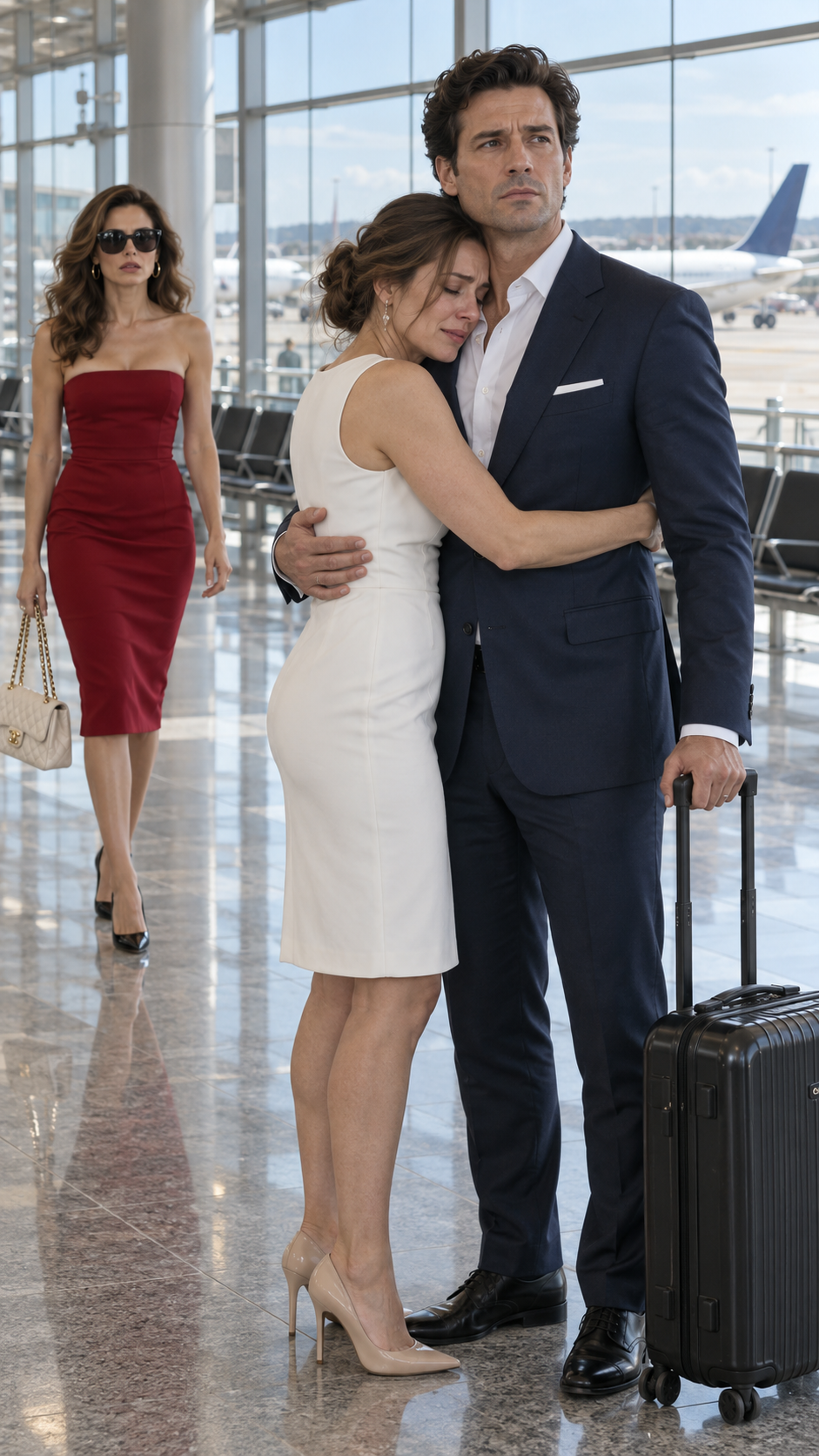
Except there was no job in Canada.
There was Clarissa Bennett, an accountant who worked with my home décor company, Abigail’s Haven.
Three nights before Brandon’s departure, I came across messages on his laptop that exposed the entire scheme.
Clarissa had reminded him to act emotional at the airport so I wouldn’t suspect anything.
Their conversations included details about their flight to London, hotel bookings, and plans to move additional money once they reached Europe.
One message said, “She’s way too gullible.
She’ll cry at the airport like a fool and then sit around waiting for months.”
I never confronted Brandon.
Instead, I saved copies of the messages, downloaded bank records, photographed invoices, hired a private investigator, and contacted my attorney, Rachel Sanders.
I also verified that the home I had inherited, the proceeds from a property in Tucson, and a substantial portion of my business assets were protected under our prenuptial agreement.
At the airport, Brandon kissed me on the forehead and said he loved me.
“Me too,” I answered.
It was the final lie I ever told him.
Once he vanished beyond airport security, my investigator confirmed that Clarissa was booked on the same flight to London.
He even sent me photographs of the two of them holding hands near the departure gate.
I drove straight to the bank.
I canceled Brandon’s authorized access to my business accounts, secured all of my separate property, and blocked several questionable transactions.
In the process, I protected more than eight million dollars.
It didn’t take long for Brandon to start calling.
His company credit card had suddenly been declined.
The hotel couldn’t bill anything to my account.
He wanted to know what was going on.
I refused to respond until after Rachel and I had completed the divorce filing.
When I finally returned his call, he immediately accused me of stealing from him.
“No,” I told him.
“I protected my money, my business, and my property.
And I know everything about Clarissa, London, and the transfers.”
The silence on the other end confirmed all I needed to know.
Then came the threats.
But before long, I discovered something far more serious.
Debt collectors showed up at a storefront I was considering leasing for a tea shop.
They claimed Brandon owed more than a million dollars and said my home and company had supposedly been pledged as collateral.

Rachel started investigating and uncovered forged paperwork carrying a signature that looked almost identical to mine.
Brandon had established shell companies, borrowed money, created fake invoices, and used the reputation of my business to back unsuccessful ventures and personal debts.
He hadn’t merely been planning to escape with Clarissa.
He had been stealing my financial identity.
Eventually, digital evidence, handwriting experts, emails, and computer access records proved that the signatures on those documents were fraudulent.
Meanwhile, Brandon’s dream life in Europe quickly fell apart.
Without access to my money, he and Clarissa could no longer afford their luxury hotel.
Their relationship began unraveling almost immediately.
His voicemail messages changed from angry accusations to desperate pleas, and eventually to attempts to blame Clarissa for everything.
Later, Brandon’s father, Howard, discovered documents his son had hidden in his basement.
Among them was a handwritten note that read:
“When the news about Europe comes out, Abigail will assume it’s only about the affair.
That should give us enough time to deal with the unauthorized loans.”
That discovery became another powerful piece of evidence in my case.
While the legal proceedings continued, I finally opened the small tea house Brandon had always ridiculed.
I named it After the Storm.
The coffee shop next door belonged to my neighbor, Thomas Mercer.
He was a widower raising his nine-year-old daughter, Chloe.
Unlike Brandon, Thomas helped me simply because he wanted to, never expecting anything in return.
On opening day, I was terrified that no one would show up.
Slowly, however, customers began arriving, and before long, the tables started filling.
That same afternoon, Brandon called me from overseas.
“Clarissa left me.
People I owe money to are coming after me.
I don’t have anywhere to live.
I need you to help me.”
For one brief second, the old part of me that always rushed to save him came back.
Then I answered, “You left me first, Brandon.
I’m simply choosing not to remain in the place where you abandoned me.”
Months later, forensic investigators officially cleared me of responsibility for Brandon’s fraudulent debts.
Criminal cases involving forgery and financial fraud followed.
Brandon eventually returned to the United States with no money, no Clarissa, and serious legal problems waiting for him.
Nine months after our farewell at the airport, our divorce was finalized.
Outside the courthouse, Brandon asked me whether I had ever really loved him.
“Yes,” I replied.
“That’s exactly why it took me so long to accept the person you had become.”
Thomas and Chloe were waiting nearby.
“The storm is finally over,” I told Chloe.
“Then it’s tea time!” she shouted happily.
During the following year, After the Storm became a popular gathering place in the community.
Thomas and I gradually developed a deeper relationship.
A year later, Brandon sent me a letter saying he finally realized he had lost far more than money.
I never answered.
I had come to understand that accepting someone’s apology does not mean you have to reopen a door that required everything in you to shut.
For years, I had convinced myself that enough patience could save my marriage.
Eventually, I realized that patience without mutual respect does nothing except extend the pain.
Brandon lost his money, his reputation, his relationships, and the one person who had always been there to rescue him.
But that wasn’t the real conclusion to my story.
The real ending was that I finally stopped allowing someone else to determine my value.
Life doesn’t improve simply because the person who shattered your heart decides to return.
It improves when you finally stop waiting for them to come back.


