A single sentence shattered the silence in family court.
“She was always good at carrying burdens and being controlled.”
The words sliced through the room like a blade. No one moved. No one dared to look at the judge first.
In the middle of a tense divorce hearing, Alejandro humiliated the woman he had called his wife for nineteen years — just as he had done for years behind the closed doors of his luxurious estate.
But this time, he made the mistake of doing it in public.
The courtroom in Guadalajara was packed to the last seat. Alejandro was a powerful businessman in Jalisco’s tequila tourism industry — the owner of ranches, luxury restaurants, horseback riding tours, and exclusive events.
Lucía, forty-one years old, had spent years smiling beside him in magazines and at high-society gatherings. To outsiders, they looked like the perfect couple.
What no one saw was that Lucía had built a large part of that empire herself.
She handled the finances, took care of international clients, coordinated workers, organized deliveries, prepared guest accommodations, and solved crises at all hours of the day and night.
When staff were missing, she stepped in herself — even doing physically demanding work in the middle of the night. Still, Alejandro never made her an official business partner.
He never paid her a fair share. On paper, she was simply “the wife.”
When Lucía demanded half of the wealth built during their marriage, Alejandro reacted the only way he knew how: with humiliation.
“She wants everyone to believe she built this company on her own,” he said mockingly, an arrogant smile spreading across his face. “The truth is, she was only ever good at taking orders.”
The judge immediately ordered the insult to be entered into the official record. But Alejandro remained confident, convinced that he still controlled the entire room.
During the recess, Lucía’s attorney, Mariana, quietly told her she did not have to continue if it was too painful. Lucía answered calmly:
“If I stay silent one more time, he wins again.”
When the hearing resumed, the judge asked whether any additional evidence needed to be presented before closing arguments. Slowly, Lucía stood.
“My husband says I was easy to control,” she said in a steady voice. “And he is right. For years, he trained me to obey.
But today, I am not here to argue. I am here to show the price of that obedience.”
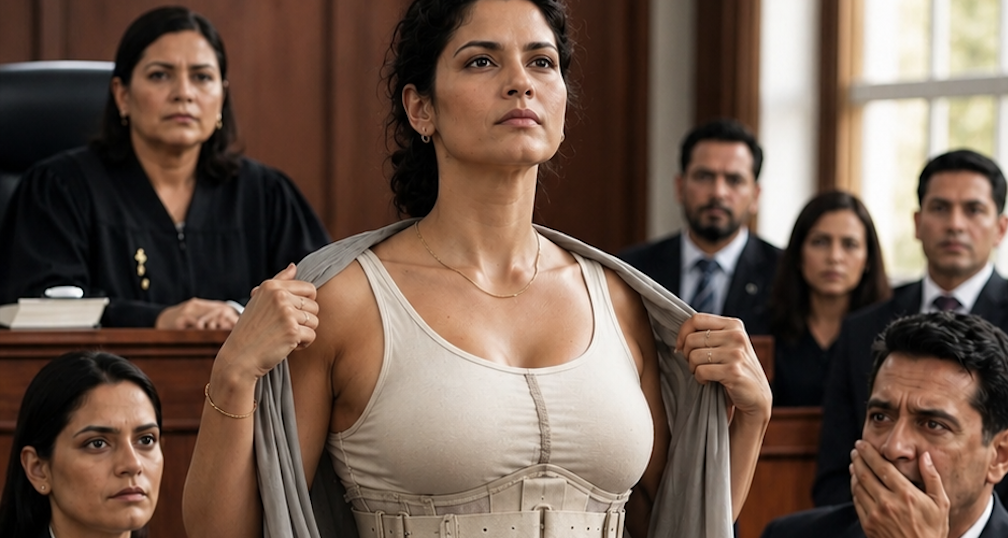
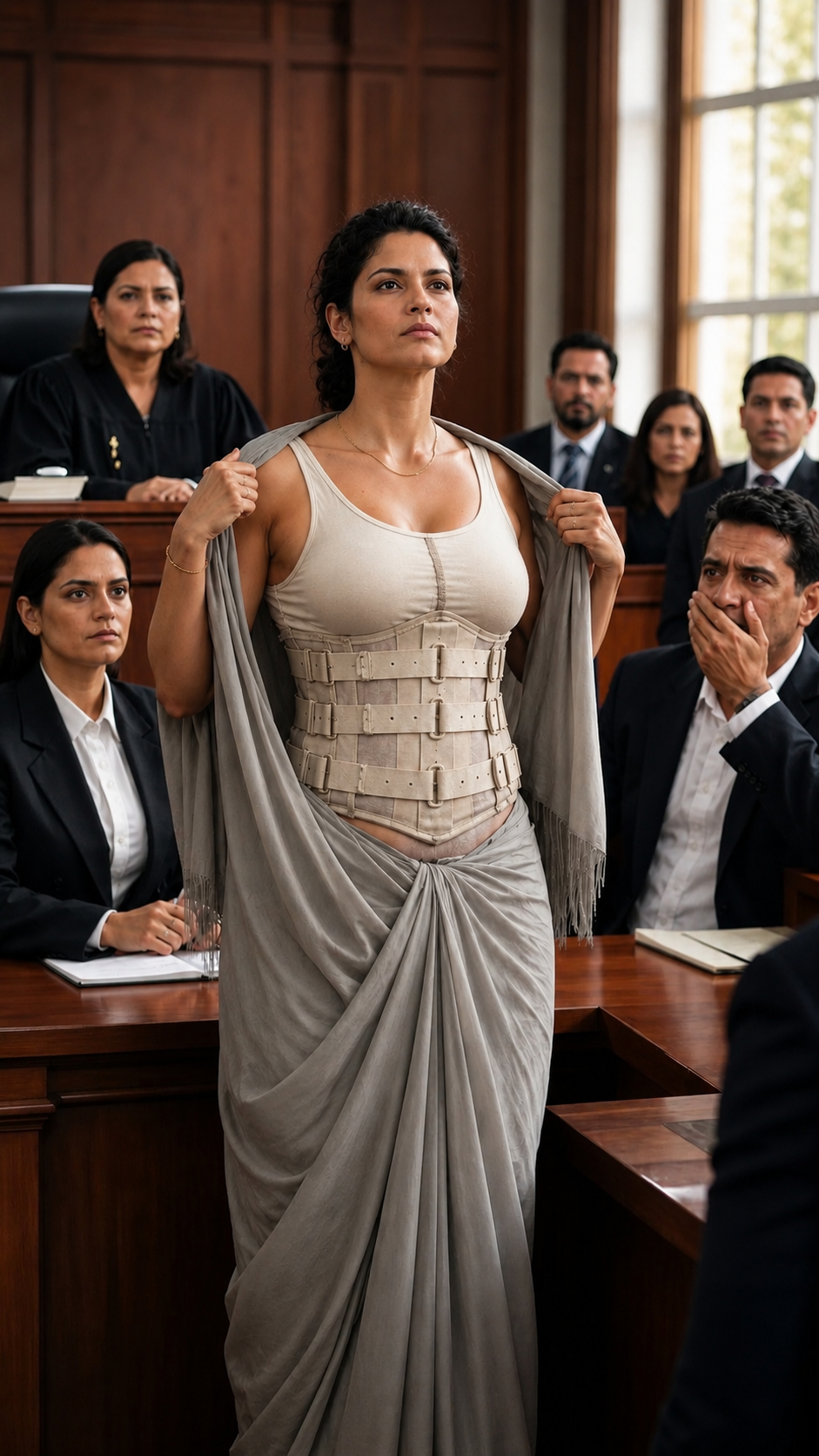
Then she slowly unzipped the side of her dark blue dress.
Underneath, she wore a tight medical compression garment and a rigid orthopedic brace around her torso. The entire courtroom froze.
Thick surgical scars ran from her collarbone down to her hip.
“These are the results of a fractured spine, multiple broken ribs, and a reconstructed hip,” she said calmly.
“According to my husband, I simply fell down the stairs.”
Hospital medical reports were submitted as evidence. Lucía explained that years earlier, during the most stressful tourist season, she had been sick and completely exhausted.
Despite her condition, Alejandro forced her to carry heavy deliveries across the entire property.
“When I told him I couldn’t do it anymore,” she said, touching the brace, “he only replied, ‘You can handle it. That’s what you’re here for.’”
Officially, Alejandro had claimed she had fallen by accident. But in court, Lucía told the truth: during an argument, he grabbed her arm and shoved her.
When she lay injured on the ground, he threatened her and ordered her to stay silent so she would not ruin the business during peak season.
Alejandro exploded with anger and shouted that she was lying, but the judge silenced him immediately.
Then Mariana called Don Tomás, the ranch foreman, to testify. Visibly weighed down by guilt, he admitted that he had seen the aftermath of the incident.
He had heard Alejandro threaten Lucía, and he confessed that he had stayed quiet because he was afraid of losing his job.
He also described harsh working conditions and confirmed that Alejandro had hidden money through illegal side accounts.
The atmosphere in the courtroom changed instantly. This was no longer just a divorce. It was the collapse of an entire empire.
Mariana presented bank records, secret transfers, and financial documents proving that Lucía’s inheritance had been used to renovate Alejandro’s businesses,
while he had secretly moved money into shell companies under his relatives’ names.
Then came the final blow: a black notebook Lucía had kept hidden for eleven years.
Inside were handwritten records of hidden cash payments, sales, expenses, and undeclared profits. Mariana compared the entries with Alejandro’s secret accounts.
Expensive horses, luxury vehicles, and land purchases had been partly financed with money that came directly from Lucía’s work and her personal savings.
But the worst evidence was the emails.
“We need to make sure she gets nothing,” Alejandro wrote to his accountant.
Another message read: “If she talks about her back injury, we’ll simply claim she already had those problems before.”
A stunned silence filled the courtroom.
Then Mariana called the couple’s eighteen-year-old daughter, Ximena, to the stand.
With a trembling voice, Ximena admitted that she had overheard her father after the accident.
She had heard him call Lucía “useless.” She described watching her mother cry through the painful rehabilitation process while Lucía still tried to protect her daughter from the full truth.
She also submitted threatening messages in which Alejandro wrote that he would throw Lucía out onto the street with nothing if she dared to ask for money.
For the first time, Alejandro no longer looked powerful.
Three weeks later, the judge delivered a devastating ruling. Lucía was awarded half of the marital assets, along with a substantial financial compensation.
Alejandro’s accounts were frozen, and the case was referred to law enforcement for abuse, assault, and fraud.
The judge stated clearly that Alejandro’s public humiliation of Lucía reflected years of psychological and physical abuse.
Outside the courthouse, Alejandro left without a trace of his former arrogance.
A few minutes later, Lucía stepped outside and wrapped Ximena tightly in her arms on the courthouse steps. No cameras. No grand speeches. Only pure relief.
Months later, Lucía had quietly and determinedly rebuilt her life.
She founded a successful consulting firm that helped struggling hotels and ranches recover financially.
Her experience surviving chaos made her exceptionally skilled at saving businesses on the brink of collapse.
The last time she saw Alejandro was at a notary’s office, when the final documents for the division of assets were signed. Before leaving, she looked at him calmly and said:
“I was never your beast of burden, Alejandro. I was the foundation holding everything up.”
He had no answer.
As Lucía stepped out into the warm Guadalajara afternoon, she finally understood something essential: kindness is not weakness, silence is not surrender, and enduring abuse has nothing to do with love.
Real life begins the moment your truth no longer apologizes for existing.