
The instant my father told the emergency-room doctor, “We’re leaving right now,” she stopped paying attention to him and turned her focus directly to me.
Then, without saying much, she closed my medical chart, walked into the hallway, and placed a phone call.
Dad assumed she was contacting someone to arrange my discharge.
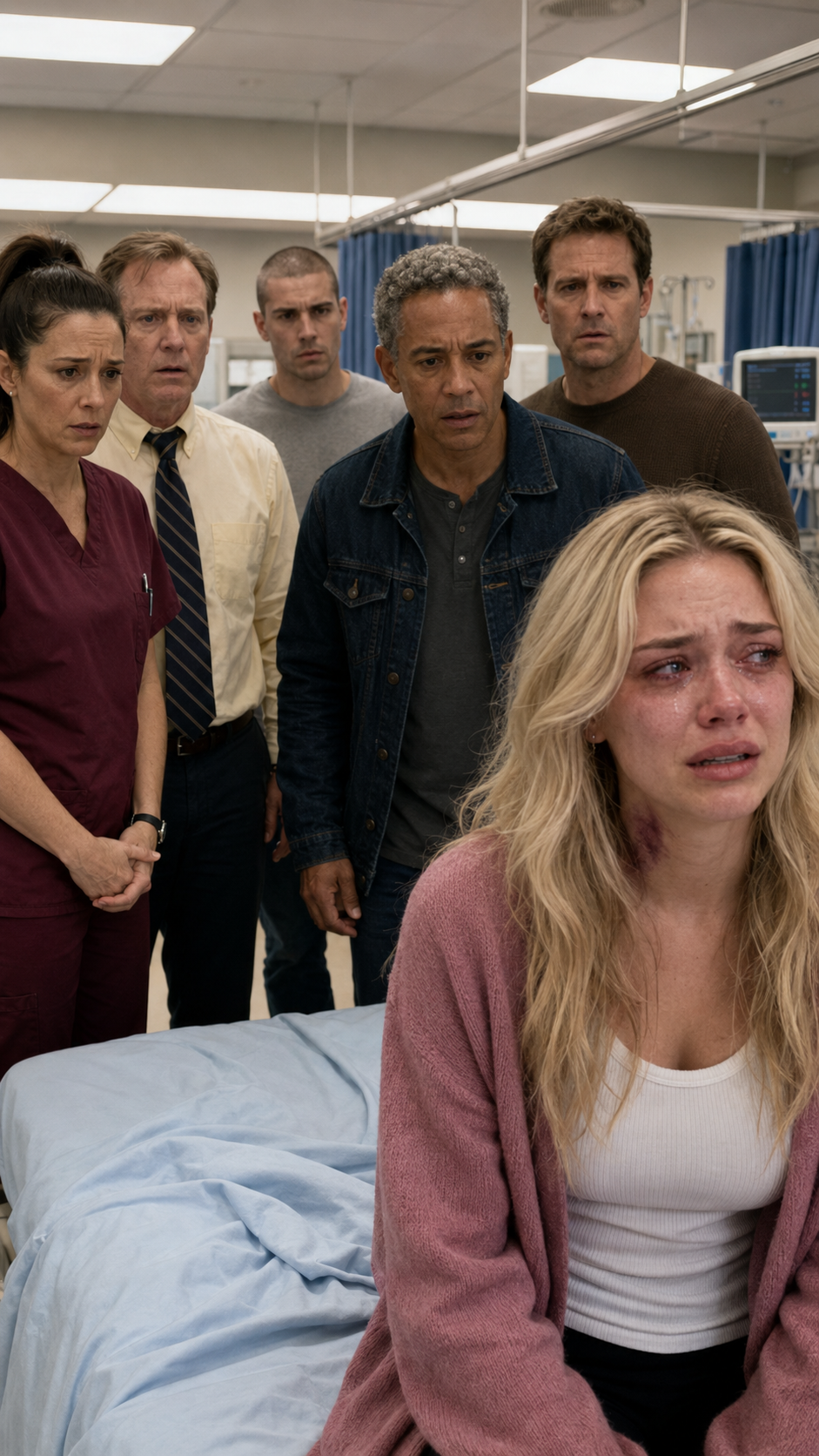
He was mistaken.
About twenty minutes later, two hospital administrators entered the room with a woman wearing an official identification badge.
That was the moment my father’s smile finally disappeared.
What he had no idea about was that I had been quietly preparing for this exact moment for nearly a year.
And the small silver pendant hanging around my neck held enough recordings to turn everything upside down.
PART 1: THE NIGHT SOMEONE FINALLY ASKED ME
My name is Emma Mercer.
I was twenty years old when I learned that sometimes the most important question a person can ask is also the most straightforward:
“Emma, what happened?”
My father, Daniel Mercer, stood next to my hospital bed dressed in one of his costly gray suits.
My mother, Patricia, sat by the window, her hands tightly clasped in her lap.
My older brother, Caleb, leaned against the wall while staring down at his phone.
Dad had already given the doctor his version of events.
“There was a disagreement at home,” he explained.
“Emma got emotional and lost her footing on the basement stairs.
That’s all there is to it.”
Dr. Elena Ramirez turned toward me.
“Emma?”
Dad answered for me again.
“She already explained what happened.”
Dr. Ramirez didn’t even look in his direction.
“I asked Emma.”
The room went quiet.
Silence was nothing unusual in our household.
It was how we got through conversations nobody wanted to have.
My father owned Mercer Development, one of the biggest construction firms in the county.
His picture regularly appeared in newspapers.
He funded charity events, donated money to local schools, and shook hands with politicians.
Everyone knew who Daniel Mercer was.
Everyone admired Daniel Mercer.
But behind closed doors, Dad possessed a very different kind of skill.
He could make you doubt your own recollection of events.
If he confiscated my phone during an argument, he would later claim that I had simply lost it.
If my bedroom door ended up damaged, he would insist it had already been that way.
When my laptop suddenly vanished after he learned that I had applied to colleges several states away, Dad told me he had sent it out to be repaired.
I never saw it again.
Mom always urged me to let things go.
“Your father is only worried about you.”
Caleb was far more direct.
“Why do you always have to cause trouble?”
Eventually, I stopped fighting back.
But I began documenting everything.
Screenshots.
Emails.
Dates.
Pictures of damaged possessions.
Copies of college correspondence.
Voicemail messages.
And eventually, audio recordings.
Six months earlier, I had bought a miniature recording device and concealed it inside a cheap silver pendant.
No one noticed.
Especially not Dad.
Dr. Ramirez moved closer to the side of my bed.
“Would you like to talk to me privately?”
Before I had a chance to respond, Dad reached for his coat.
“There’s nothing more to talk about.
We’re taking her home.”
The doctor studied him for several seconds.
Then, in an even voice, she replied:
“No.”
Dad actually laughed.
“Excuse me?”
“I want to speak with your daughter alone first.”
“You don’t understand how our family works.”
“That is exactly why I want to hear Emma’s side.”
Dad’s face shifted.
He wasn’t used to being disregarded.
Then he looked at me.
I knew that expression immediately.
Don’t say a word.
We’ll handle this when we get home.
I dropped my gaze.
Dr. Ramirez shut my medical chart.
Then she walked into the hallway and made a call.
Roughly twenty minutes later, a patient advocate named Mara Jenkins entered the room accompanied by two hospital administrators.
Mara asked my family to step outside.
Dad immediately objected.
“I’m her father.”
“And Emma is an adult,” Mara answered calmly.
“She is capable of speaking for herself.”
For the first time that evening, no one bothered asking my father for approval.
The door shut behind them.
Mara pulled a chair over beside my bed.
“You can speak freely here.
This conversation is private.”
My hands began to shake.
“What happened tonight?”
I kept my eyes fixed on the floor.
“Dad found out about my scholarship application.”
“Why would that lead to an argument?”
“Because the university is six hundred miles from here.”
Mara remained silent, giving me time.
Eventually, I raised my eyes to hers.
“He doesn’t want me to leave.”
“Why not?”
“Because once I’m gone, he won’t be able to control what I tell people.”
The room fell completely quiet.
Then I reached behind my neck and unfastened the silver pendant.
I placed it into Mara’s palm.
She studied it carefully.
“What is this?”
“A recording device.”
Her gaze immediately rose to meet mine.
“How long have you been recording things?”
“Six months.”
“And what exactly have you recorded?”
I swallowed hard.
“My family telling the truth whenever they believed no one else could hear them.”
PART 2: THE RECORDING THAT CHANGED EVERYTHING
The recordings didn’t expose one enormous, shocking secret.
Instead, they uncovered dozens of smaller truths.
Dad demanding the password to my email account.
Caleb admitting that he had taken my phone.
Mom warning me not to talk about certain family arguments with outsiders.
Dad instructing someone at his company to stop a payment related to my college application.
There were also emails proving that he had contacted universities behind my back.
Financial documents revealed that money from an education fund created by my late grandmother had been transferred somewhere else.
That immediately drew Mara’s attention.
But another recording concerned her even more.
It was nearly two years old.
I had completely forgotten it was there.
Dad and Mom were arguing inside his office.
Mom sounded uneasy.
“What if Sophie says something?”
Dad answered:
“Sophie is done. Her parents agreed to let it go.”
Mara stopped the recording.
“Who is Sophie?”
My stomach twisted.
“My cousin.”
Sophie had stayed with our family for several months when I was younger.
Then, almost without warning, she vanished from our lives.
Dad told me her parents had suddenly relocated.
Mom wouldn’t talk about it.
Caleb once said Sophie had “made trouble.”
That was the only explanation I ever got.
“Do you know where she is now?”
“No.”
Mara wrote down Sophie’s complete name.
By midnight, what had begun as a private conflict within our family had grown into something far more serious.
Investigators started examining the financial activity tied to my education fund.
They also began trying to locate Sophie.
Dad stayed in the hallway, completely convinced that his attorneys would have the situation under control by morning.
Then he made a disastrous mistake.
He called the company office and urgently instructed an employee to collect several boxes of private documents from our home.
Someone close enough to hear part of the conversation became suspicious.
The records were secured before anyone could remove them.
Inside Dad’s office, investigators found old counseling reports.
College letters and documents addressed to me.
Paperwork related to the education trust my grandmother had established.
And one envelope with a single name written across the front.
SOPHIE.
Inside was a letter she had written years before.
Sophie explained how controlled and pressured she had felt while living with our family and why she had begged her parents to take her away.
But there was more.
A financial settlement.
My parents had secretly paid Sophie’s family after she left.
The payment had been buried in company records under the label of a consulting expense.
At that point, investigators were no longer focused only on what had happened inside our home.
They were now questioning whether Mercer Development had been used to conceal private financial dealings.
Shortly before sunrise, Mara came back into my hospital room.
Something in her expression had changed.
“We located Sophie.”
I stared at her.
“Where is she?”
“Colorado.”
“Does she remember what happened?”
Mara moved her chair closer.
“She remembers all of it.”
My heart dropped.
Then I asked the question I was almost too afraid to say out loud.
“Is she willing to talk?”
Mara gave me a faint smile.
“Emma, she’s already talking.”
Through the glass, I could see my father sitting in the hallway.
His phone was no longer glued to his ear.
Caleb had stopped smiling.
Mom kept her eyes fixed on the floor.
For years, Daniel Mercer had controlled every version of every story our family told.
Now two young women were finally telling their own.
And unlike Dad’s story, ours was supported by evidence.
PART 3: THE MERCER FILES
The investigation continued for months.
It exposed suspicious payments made through the company.
Money that had been taken from my education fund.
Old correspondence Dad had tried to keep hidden.
Employees who had been directed to handle private family matters using company accounts.
Eventually, Mercer Development’s board launched an independent investigation of its own.
Dad was temporarily suspended from running the company.
Soon after, several board members resigned.
Business partners started demanding explanations.
Former employees began coming forward.
Suddenly, the admired businessman everyone thought they knew looked very different once his actions were documented on paper.
At first, Caleb tried to blame everything on Dad.
That strategy didn’t last long.
Several recordings showed that Caleb had knowingly helped hide my phone, intercept my mail, and gain access to accounts that were not his.
Mom claimed she had only been trying to keep the family safe.
Eventually, she admitted the truth.
What she had really been protecting all those years was the family’s reputation.
Sophie returned.
Seeing her again felt surreal.
She was no longer the terrified teenager I remembered.
She was twenty-one now.
Self-assured.
Composed.
And carrying a folder thick enough to make Dad’s attorneys visibly nervous.
Months later, when formal proceedings finally started, Dad’s lawyers attempted to paint me as a bitter daughter seeking revenge.
Then one of my recordings was played.
My father’s voice echoed through the room.
No one interrupted.
There was no reason to.
For years, Dad had counted on one thing above everything else:
People trusted him more than they trusted me.
He never considered the possibility that one day, I would simply let them hear his own words.
The legal and financial consequences unfolded slowly.
Mercer Development restructured its leadership.
The money improperly removed from my education fund was returned.
Several suspicious company transactions were examined in separate investigations.
Sophie finally received answers about what had happened to her years earlier.
And eventually, my mother said something I had waited years to hear.
“I should have said something sooner.”
I wasn’t sure whether I would ever forgive her.
But forgiveness was no longer something anyone had the right to demand from me.
The final time Dad and I spoke, he looked straight at me and said:
“You ruined everything I built.”
I considered his words for a moment.
Then I shook my head.
“No. I just stopped helping you cover up the damage.”
Eighteen months later, I moved six hundred miles away.
The scholarship my father had tried to prevent became the first step toward an entirely different future.
I began studying forensic psychology.
Sophie lived close by, and little by little, we rebuilt the connection we had lost.
My apartment was nothing luxurious.
One bedroom.
A cramped kitchen.
Used furniture.
Plants crowded along the windowsill.
But everything inside that apartment was mine.
My phone.
My laptop.
My mail.
My decisions.
One Saturday morning, an envelope arrived with Dad’s handwriting across the front.
I stood next to the mailbox holding it for several seconds.
Then something occurred to me.
I wasn’t obligated to read it.
So I didn’t.
I dropped the envelope into the recycling bin and headed toward the coffee shop where Sophie was waiting for me.
Halfway there, my phone started ringing.
I glanced at the screen.
It was my professor.
I answered.
Behind me was the family that had taught me how to stay silent.
In front of me was a life where I could finally use my own voice.
My father had spent years believing that whoever controlled the narrative also controlled the truth.
He was mistaken.
Because sooner or later, someone stops repeating your version of the story—
and begins telling their own.


