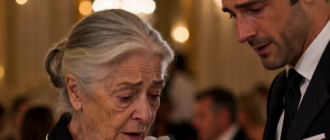
He Took His Mute Triplet Daughters to Work — but What the Waitress Did Next Left Him Completely Stunned

The morning breakfast rush at the rooftop dining room of Whitmore Holdings typically felt like a precisely choreographed performance—glassware gently tapping, hushed financial discussions, and the constant undercurrent of global business being decided over coffee. That morning, however, an unusual quietness clung to a single corner table near the panoramic windows.
Daniel Whitmore sat there in a perfectly cut charcoal suit, his posture controlled but visibly strained, as though held together by discipline alone. The faint shadows beneath his eyes told the story of a man who had not known real rest in a long time. Across from him sat the only part of his world that still mattered: Lily, Emma, and Sophie—his identical triplet daughters. Each wore a soft pink dress, each carried the same heavy silence.
Ever since Clara, their mother, died eight months earlier, the girls had not spoken a single word. Doctors called it trauma-related mutism. Daniel called it something far worse—an absence that filled every room of his life.
“I have a meeting. I’ll be back soon,” he said quietly, lowering himself to their height. The three girls responded with identical, perfectly timed nods. No complaints, no expression—just a silence so dense it seemed to press against the air itself.
He turned away, signaling the staff as his mind drifted back toward contracts, numbers, and responsibilities. But halfway toward the elevators, he hesitated. Something pulled him back.
A young waitress had approached the table. Her name tag read Maya. Unlike the others, she didn’t try to force smiles or speak in exaggerated cheerfulness. Instead, she simply knelt down so she was level with the children.
From her apron pocket, she carefully took out a small teddy bear tied with a blue ribbon—the exact shade as the girls’ hair bows.
Daniel stopped moving.

Maya said nothing. Instead, she lifted her hands.
Her fingers began to form clear, deliberate shapes in the air. Sign language—smooth, practiced, and instinctive, as if it had always been part of her. The effect was immediate. Emma, usually the most withdrawn, hesitated… then slowly raised her own hands. Uncertain at first, she mirrored Maya’s movements.
Within seconds, Lily and Sophie joined in.
The silent table transformed. What had been emptiness became motion. The girls’ hands followed Maya’s rhythm, their eyes sharpening with recognition and curiosity. Daniel stood frozen, watching a sight he had not seen since before the funeral—his daughters communicating.
He slowly stepped closer, as if afraid that sound or movement might shatter what he was witnessing.
“My brother is deaf,” Maya said softly without stopping her gestures. “I learned early that silence isn’t emptiness. It’s just another way of speaking.”
She translated as the girls expressed themselves. Sophie wanted a tea party for the teddy bear. Lily insisted the bear was lonely and needed a family of its own. Then all three girls turned toward Daniel at once and formed a sign he remembered from long ago—before grief had changed everything.
“Daddy.”
No voice accompanied it, but it struck deeper than words ever could.
For the first time in months, Daniel felt something inside him crack open.
He understood then what he had failed to grasp despite every specialist, therapist, and expert he had hired. His daughters were not unreachable—they were unheard. Their silence was not emptiness; it was language waiting for someone willing to learn it.
“Work with my family,” Daniel said abruptly, his voice unsteady. “You’ve done more in minutes than anyone else has managed in a year.”
Maya looked surprised. “I’m just a waitress. I didn’t do anything special.”
But Daniel shook his head, watching as his daughters smiled silently while teaching the teddy bear to wave. “That’s where you’re wrong,” he said quietly. “You understood them when no one else even tried to listen.”
Later, Maya mentioned something Daniel had forgotten: Clara had once taught the girls basic sign language during her charity work. It had never been forgotten—only buried beneath grief. Maya had not created a solution; she had simply rediscovered a bridge that already existed.
As evening light spread across the city skyline, Daniel remained at the table long after everything else faded into routine again. For the first time in a long while, he did not look at his phone or think about work. Instead, he awkwardly copied Maya’s hand movements, slowly learning the language his daughters trusted most.
And in that quiet learning, he finally realized something simple yet life-altering: sometimes healing does not come from fixing what is broken, but from learning how to hear what was never spoken out loud.