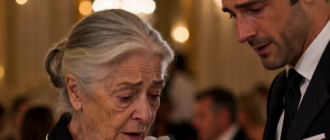
A wealthy father had designed a flawless medical routine to safeguard his paralyzed twin sons—until the day he returned home unexpectedly and discovered them lying on the floor beside the housekeeper, unaware that a single subtle movement would begin to unravel everything he thought he knew.

Graham Holloway had never intended to arrive home before sunset.
For nearly two years, his life had followed a rigid, almost mechanical rhythm. He left the house before his sons were fully awake, spent endless hours in a glass-walled office tower in downtown Raleigh, and came back only after nightfall to a home that felt silent in all the wrong ways. His staff maintained perfection. His schedule never slipped. Every space looked immaculate.
Yet nothing inside that house felt truly alive.
That Thursday, a meeting with investors ended sooner than expected after a delay pushed negotiations into the following week. Graham could have stayed in the city, losing himself in spreadsheets and projections, but he no longer had the energy to pretend. At the gates of his estate in Wake Forest, North Carolina, he dismissed his driver and chose to enter quietly through the side door, alone.
It reminded him of how his late wife used to surprise him. She would hear the door open, laugh somewhere down the hallway, and call out that dinner was nearly ready. Sometimes their twin boys would come running toward him before he even had time to put his bag down.
Those memories had become almost unbearable.
As Graham stepped into the stillness of the house, loosening his tie, he expected the usual emptiness. Instead, a sound stopped him in his tracks.
Children laughing.
Not from a television. Not from a tablet. Real laughter—light, breathless, and completely free.
For a brief moment, he wondered if his mind was playing tricks on him.
Then he followed the sound.
The Room That Stole His Breath
The laughter led him down the east hallway to the rehabilitation room he had built after the accident. He pushed the door open—and froze so abruptly his shoulder hit the frame.
Both wheelchairs were empty.
His heart pounded painfully in his chest.
On the padded floor lay his sons, Declan and Wesley Mercer—eight years old, identical except for the faint scar above Wesley’s eyebrow from a childhood fall, long before everything had changed. They were on their backs, knees bent, bare feet pressed against foam wedges and small wooden blocks.
Beside them was Naomi Bell, the housekeeper he had hired just three months earlier.
She wasn’t panicking. She wasn’t rushing. There was nothing careless or chaotic about her actions.
She was calm.
One of her hands supported Declan’s hips, while the other rested gently on Wesley’s knee. Her movements were slow, controlled, almost rhythmic—like a quiet melody. Under her breath, she hummed a soft tune Graham had never heard before, something about rivers, sunlight, and moving forward one inch at a time.
The boys weren’t afraid.
They were smiling.
Graham’s mouth went dry.
Every specialist Graham Holloway had hired had warned him about risk—about positioning, alignment, pressure, and the danger hidden in every movement. He had learned to treat even the smallest transfer like a crisis waiting to happen. So when he saw Naomi on the floor with his sons, fear cut through him instantly.

“What are you doing?” he demanded.
Naomi looked up, calm and steady. “Helping them feel their bodies again.”
Graham stepped closer—and froze.
Declan’s toes curled toward her fingers. Not randomly. On purpose. Wesley pressed his foot against a block, trembling with effort, then laughed in surprise.
“That’s not possible,” Graham whispered.
“It is,” Naomi replied softly. “It’s just been overlooked.”
Before tragedy entered their lives, Graham had been a man defined by control. A successful founder of a software security firm, he thrived on order and precision. At home, his wife Lena had been his opposite—warm, lively, the heart of their family. She filled their home with laughter, music, and light, turning even ordinary moments into something meaningful.
Then one rainy afternoon, everything changed. A car accident took Lena’s life.
Their twin sons, Declan and Wesley, survived—but with severe spinal injuries. Doctors spoke in cautious tones: incomplete damage, uncertain outcomes, the possibility they might never walk again.
Graham responded the only way he knew how—by taking control.
He spared no expense. Specialists, equipment, therapies, schedules—he built a perfect system. The house became a rehabilitation center. Every hour was structured, every movement monitored.
And slowly, something inside the boys faded.
They stopped laughing. Stopped asking questions. Stopped being children.
Graham told himself this was protection. Discipline. Love.
But what filled the house wasn’t hope.
It was fear.
Naomi Bell entered their lives quietly. She was observant, gentle, and steady. Graham hired her to maintain order, nothing more.
But she noticed things others didn’t.
She spoke to the boys like they were still whole. Not broken. Not limited. Just children.
One afternoon, she asked them, “If you could go anywhere tomorrow, where would it be?”
“A lake,” Declan said softly.
“Skip rocks,” Wesley added.
It had been months since Graham had heard them speak like that.
Now, standing in the rehab room, Graham felt everything he believed begin to crack.
“You had no right,” he said weakly.
“I was careful,” Naomi answered. “And I listened to them.”
“The doctors said movements like that are random.”
Naomi guided Wesley’s foot again. “Press for me.”
Wesley focused—and pushed.
Small. Shaky. Real.
“That’s not random,” she said.
Graham’s voice dropped. “How long has this been happening?”
“A few weeks,” she admitted. “Slowly. Safely.”
“Without telling me?”
Naomi met his eyes. “You never asked what gave them hope. Only if they followed the program.”
That truth hit harder than anything else.
Naomi told him about her younger brother, who had suffered a spinal injury years ago. Her family had no money, no specialists—only patience, creativity, and belief. They worked on the floor, using simple tools and attention.
“He didn’t get a miracle,” she said. “But he got more than anyone expected.”
Graham realized something painful—he had trusted systems more than his own children.
The next day, Graham called his lead physician, Dr. Pike, for reassessment.
The doctor examined the boys, then dismissed the progress. “Limited response. Not meaningful recovery.”
“They’re responding on command,” Graham insisted.
“Families often misinterpret hopeful signs,” the doctor replied.
Graham felt something shift inside him.
“Show him,” he said.
The boys tried again. Focused. Intentional.
Naomi spoke calmly. “Realistic doesn’t have to mean lifeless.”
Dr. Pike stiffened. “And you are?”
“The one who listened when they stopped speaking.”
Silence filled the room.
Graham made his decision.
“I want a new team.”
That night, everything changed.
Graham sat on the floor with his sons for the first time. Awkward, unsure, but present.
“Let him lead,” Naomi whispered.
“I’m here,” Graham told Declan. “We go at your pace.”
They worked through small movements—tiny efforts that felt enormous. Wesley laughed. Declan focused harder than ever.
For the first time in months, Graham saw pride in their faces.
Tears blurred his vision.
“Did you see that?” he whispered.
“We did,” Wesley grinned.
Within weeks, a new medical team confirmed what Naomi had seen: the boys had preserved pathways, real potential. Progress would be slow—but possible.
Graham dismantled the rigid system. Therapy became balanced with play, music, and time outdoors. The house began to breathe again.
He offered Naomi a new role coordinating their care.
“You treated them like they still belonged to themselves,” he told her. “That matters more than any title.”
Spring arrived, and with it, something the house had been missing.
Laughter.
It echoed through the rooms—during therapy, in the backyard, even from Graham himself. The boys still struggled. There were hard days.
But their story was no longer defined by limits.
One evening, Graham watched them build a crooked cardboard city on the floor. Wesley explained imaginary traffic rules. Declan laughed uncontrollably.
Grief still lived in that house.
But now, hope lived there too.
Graham had spent months believing healing came from control, expertise, and certainty.
But he had been wrong.
Sometimes healing begins quietly—with patience, attention, and someone willing to see what others overlook.
Sometimes it starts with a single small movement.
And sometimes, the person who changes everything is the one no one thought to ask.